
Returning to Roots
Meditation on All Things Wild

Tonight, her name is a leaf covering
my left eye. The right I close
for the wind to stitch shut with thread

from the dress she wore into the grave
where the determined roots of the tree
are making a braid around her body.


—-Rob Schlegel, "I Pack Her Suitcase with Sticks, Light the Tinder, and Shut the Lid"
Hello Lovelies—
Buckets of gratitude for reading A Woman’s Place Is In the Wild. I appreciate all of you who sustain and help me grow these weekly meditations by reading and commenting or sharing and supporting my work with a paid subscription. Your generosity means the world to me. Thank you for being here.
Did you know you can LISTEN to A Woman’s Place Is in the Wild? Click the play button on the upper right of your screen when you go to the page of this post.
Each weekly meditation of A Woman’s Place is in the Wild is an offering, an evocation of the world around me. You will rarely find me writing about climbing to the top of a mountain or counting the miles I’ve walked as if collecting notches on a belt.
Instead, I want to adventure in.
This is the kind of nature writing needed now, narratives of place—localities, with its root in the Latin, locus, for place—the kind that rise over time out of relationship, that allow us to understand that we are place, too. As the Scottish writer, Nan Shepherd says, “The first law of ecology is that everything is connected to everything else.”
15 July, Heinäkuu - New Hay Moon
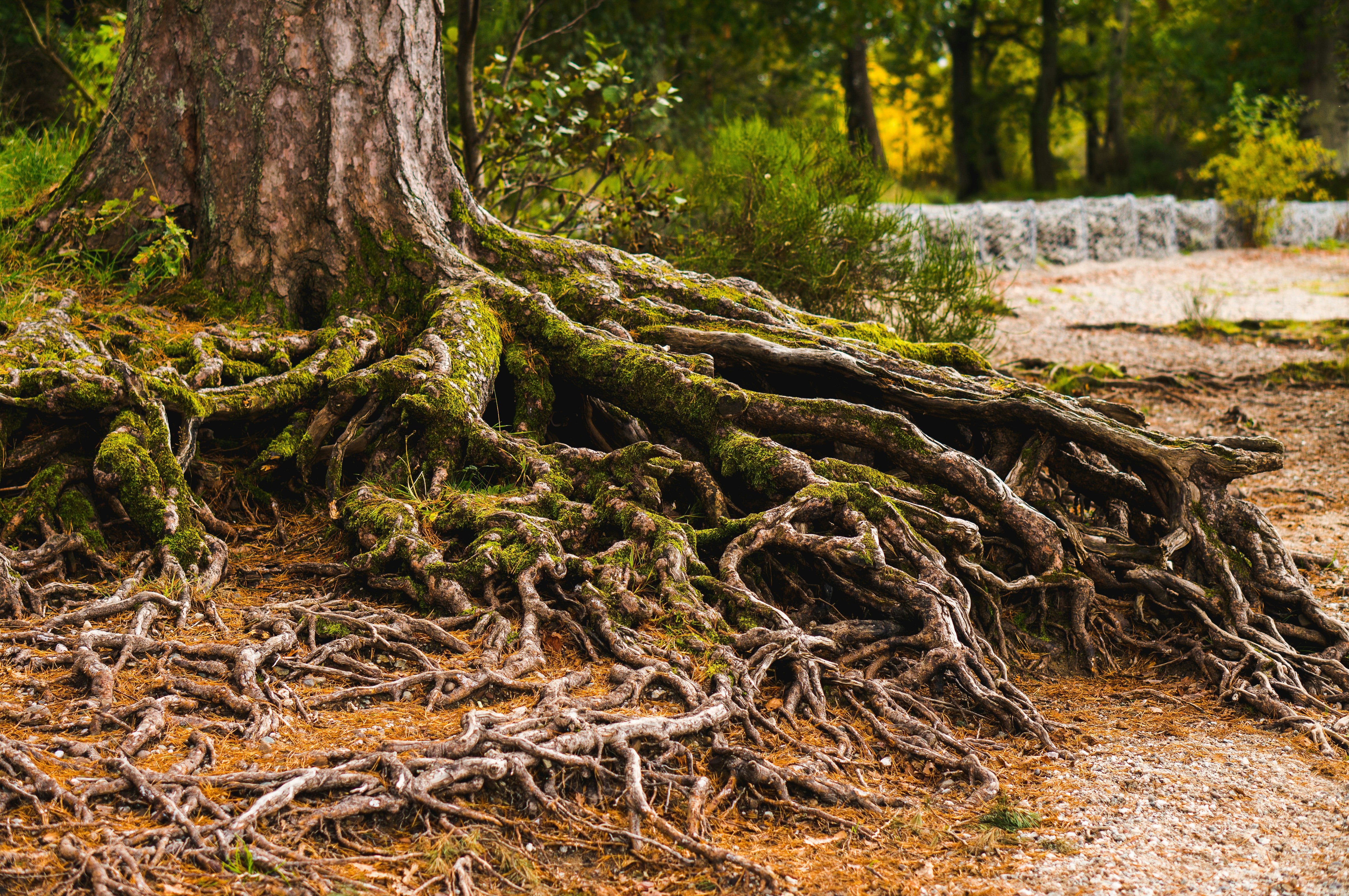
On a walk through the woods with Yuki, I find the tall root of a fallen pine, shorn from the tree. Someone had been doing a little maintenance on the loop that meanders through the gulch, cutting trees that had fallen over the path to make passage easier. We lost so many trees this year in what was one of the windiest winters yet.
Stood on one end, the root twists upward to a height to almost four feet, its two branches twining as if in a dance, the many fingers and shoots of one branch reaching for the body of the other.
Transfixed, I pick up the root and carry it home, having been tasked in a workshop I am taking about Finnish Folklore and Mythology to build a talisman. I have the urge to plant the root somewhere on the land, to let it reach upright from the forest floor.
I stand the root in the corner of my office where I keep my books and journals along with photographs of people from my mother’s line; where I collect stones and feather and bark from my walks; where I have an altar that holds many sacred things.
I think about the way Ponderosa pine roots spread out laterally. Together with the deep taproot, their root system allows them to access water at different soil depths, something that reduces direct competition with shallower-rooted grasses and shrubs in the understory.
Plus, ponderosas can perform what’s called hydraulic lift or redistribution — pulling moisture from deeper, wetter soil layers and releasing some of it into drier upper layers through its roots at night. This process can indirectly benefit both neighboring plants and microbial communities during drought periods.
I have spent so much of my life feeling rootless. From my peripatetic, Air Force-brat childhood to the cracked container of my family, I have never felt dug in.
Despite this understanding, it takes me a week to understand the obvious symbolism of the root stem.
My grandmother Alice, my mother’s mother, a woman I barely knew, has been circling my waking world as I write about her lineage in the novel I am working on.
I met her perhaps twice as a child—once traveling to her house in a small town in Illinois for a family reunion at Christmas—the only time I ever met my cousins. I was five or six, dressed in a neat pink wool mini-skirt with matching jacket and pink fur collar, shiny silver tinsel tied to the two ponytails sticking out from either side of head. My smile reveals missing front teeth, the expressions of someone who felt like the Mistaken Zygoat in that story by Clarissa Pinkola Estes.
I have one memory of Alice from that visit. I am in her sewing room and find a strawberry shaped pin-cushion which to me seems a marvel. I love the bright red felt ball that fits softly in the palm of my hand and the many-colored pins it holds.
I have never seen a pin cushion before and haven’t the first idea of what it is used for. My own mother does not sew. I do not know that women still sew.
“Do all grandmas have these?” I as,k, thinking perhaps the pin cushion goes with the job.
Alice laughs. I can tell she is delighted. Maybe she gifts the pin cushion to me, minus the pins, and I pocket it, taking it home to California where a few years later it will be lost either by carelessness or in the move to Colorado.
The next memory I have of Alice is only four years, after she has suffered a stroke and has difficulty forming words. As a result, she and my grandfather live with my family in Colorado for a time because they can no longer care for themselves.
I remember the day, a year later, when I dress my grandmother for my grandfather’s funeral, helping her into her hose and bra, pulling her dress over her head as she mumbles, “Milt, Milt,” and I explain to her over and over that he has died.
I am ten. She is 67.
I thought she was so old then, a woman disappeared behind the veil of advanced (!) age and what I concluded, as a child, must be senility.
At the time, my mother tells me she speaks the way she does because of the stroke, but it’s possible, I hear later, that Alice was also struggling with Parkinson’s, a disease that now afflicts one of my siblings.
As a child, I was appalled by Alice’s trembling hands and sack-like breasts, by her stuttering and confusion, which I mistook for old age, a place a viewed with abhorence.
Now I think of my grandmother differently.
Alice was the daughter of an Apostolic Lutheran lay pastor, by all reports a strict man, who farmed two 160 acre plots of land on the southern border of eastern North Dakota in the run up to the Great Depression. Eventually he would inherit his father’s lands to farm four plots in all—all of which he would have to auction after grain prices fell and the land dried up and blew away during the Dust Bowl.
Alice left home when she was nineteen, the only one of her ten siblings to do so, and moved to Minneapolis, nearly 300 miles away. Perhaps she went in search of a job, likely factory work, at first, perhaps she was tired of rural living; but I am convinced, because of all that came after, something made her leave.
My mother rarely spoke of Alice; all I knew of my grandmother is that she, along with my grandfather, drank too much and the house was filled with ugly, alcohol-fueled fights every weekend from Friday to Sunday. My mother once confessed that because of this, she never asked friends over.
I am certain of two things: Alice was a wild spirit who grew up in a difficult time and she lived under the thumb of difficult men, a legacy passed to my mother and then to me.
Growing up I thought I could cut myself off at the root, from stories like Alice’s, from people with whom I imagined I shared neither kinship nor sensibility.
I thought they had nothing to do with me.
But I now see now the patterns of my lineage, like roots spreading laterally beneath the surface of soil, each line twined, reaching for moisture in dry times.
And not just for themselves, but for the body of the tree to which we all belong—each in their own way.
I have stood the root gifted by the forest near me as I write this. It twines upward like a flame, another spark of my lineage, with a strong central root that reaches and a smaller one that circles it, a presence supporting the other.
Until recently I have thought my inheritance was silence—the nothing of the stories of women in my line—their disappointments, their failed love affairs and estranged children, the fact that none of them was allowed to go to college. Both my mother and her mother before her were rendered nearly mute at the end of their lives, incapable of prolonged speech. One by Parkinson’s, the other by a Giant Brain Aneurysm. Both spoke in fragments, reaching for the ghost of words, unable to make themselves understood.
But now I imagine them as the bearers of an ancient tongue, a language known only to women who for so long have gone unheard who have been like the speaker in that Emily Dickinson poem, “shut up” and kept “still.” These women, my mothers, are like Whitman, “untranslatable” and “not a bit tamed.” They speak their own language to themselves and then to me.
I close my eyes and imagine my ten year old self, receiving this transmission from Alice as I dressed her that day, as she murmured over and over. Then, I think of our determined roots twining together, holding the fragments until they become the story of what happened, to nourish not only all the women who came before, but all of us who live in this time when returning to roots—for earth, for each other—and the singing of the songs and speaking the stories that will be our resurrection.
Hold onto beauty, friends, and to each other. Carry hope. And practice being human, practice loving the earth and each other, each day. Thank you for reading.
Big love,
Karen
A Writer’s Note: If these this have brought you outside, or made you stop and look at the beauty of the natural world, please consider becoming a paid supporter. Doing so keeps this work alive.
You can also purchase a copy of Rough Beauty: Forty Seasons of Mountain Living here. or order a personalized first-edition here.
Please click the heart if you appreciate this post and of course, feel free to restack or share with friends.
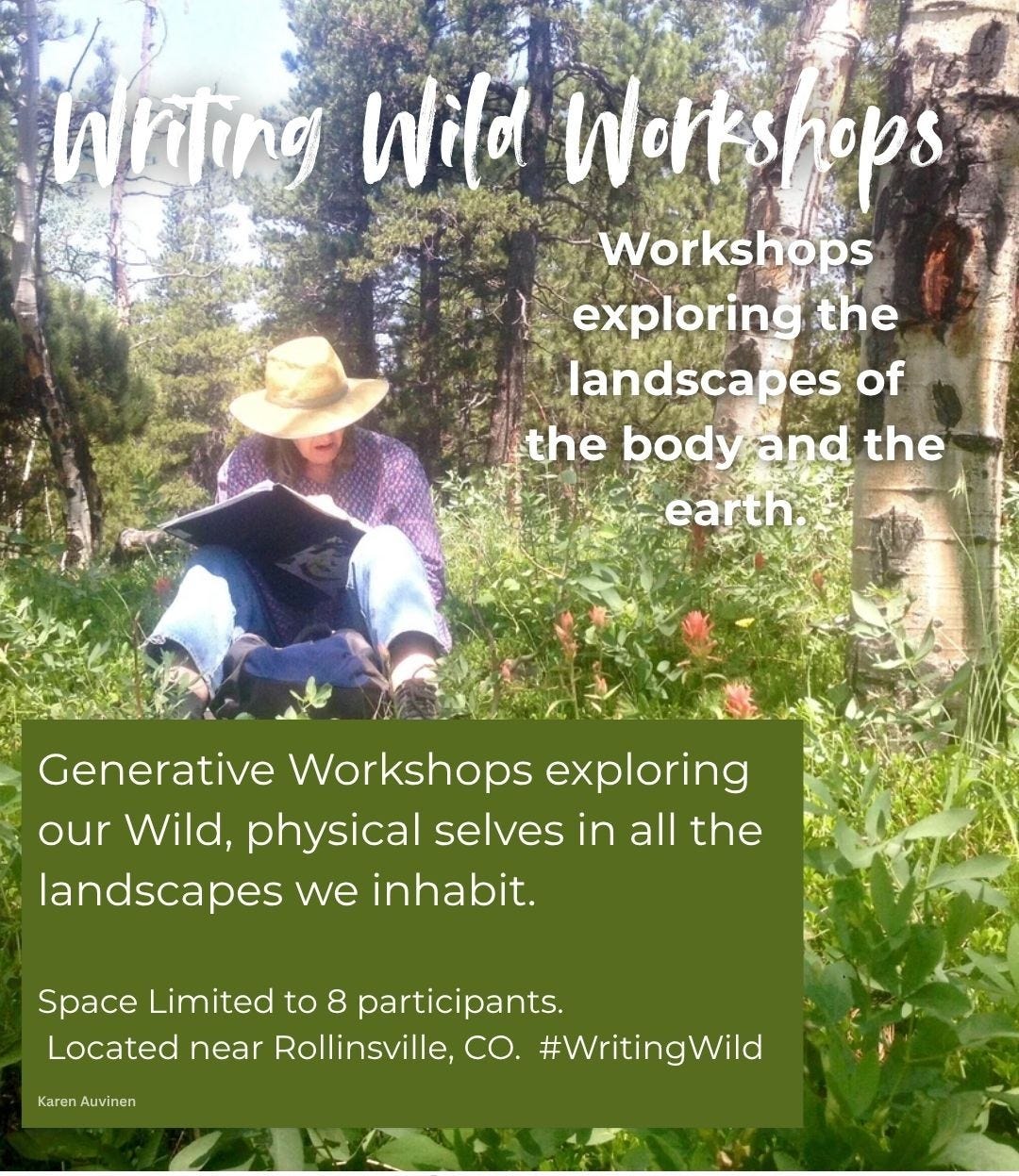
Writing Wild: Ritual
Sunday October 4th 10-3:30
6 Spaces Left
As we prepare to enter enter fall, this daylong workshop focuses on not only helping your understand your own writing rituals (best times + places for inspiration, how to keep coming back to writing over and over) in order to help you feed your creative self, but also on inspiring some new ones. Plus, we’ll take a deep dive in the mystery with an intuitive inspiration hike and using tarot cards to help us access images, stories, poems swimming in our subconscious bodies.
Thank you for sharing this powerful story of your roots. Ive been thinking about the silenced voices of women lately and about my own mother who is in the process of leaving this life. She is also at a stage where she doesn't have many words and if she does they are slurred and a mixing between two different worlds. She told me once that she never knew what her mother thought of her and yet I wonder now, what she thinks of me. Mother wounds have continued through generations, but they can also be transformed, just like what once was a tree can go back to the Earth to nourish the next tree. I wonder, though, as I sit with my own suffering if I can release her from hers with mindfulness and compassion?
Thank you for this deep contemplation.
A wonderful rendering of how many older women in our lives lived in silence, under restrictions, with lost desire and dreams. I don't think my grandmother wanted to marry, but the pressure and lack of options resulted in a life spent submerged in alcohol, hidden in her house, curtains closed more than open, mostly estranged from her siblings and community, necessary to hide her alcoholism, barely raising a daughter who grew to openly dislike and resent her. I don't think she or my mother felt rooted; I spent decades trying to grow those roots.